
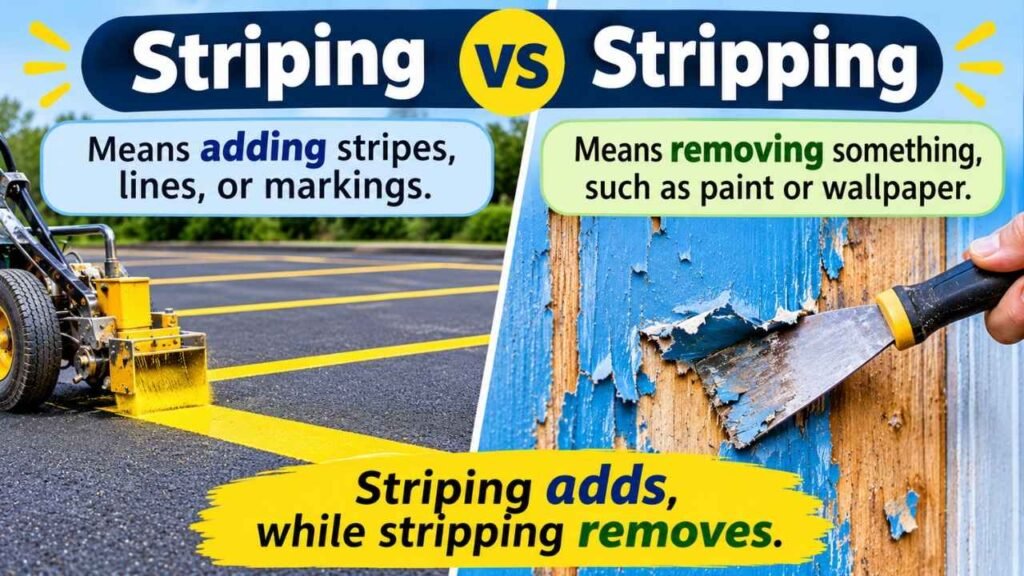

Have you ever wondered whether to write striping vs stripping? Although these words look almost identical, they describe two different actions. One relates to adding lines or patterns, while the other refers to removing something. Choosing the wrong spelling can change the meaning of your sentence completely.
The difference becomes easier to understand when you look at their original verbs. Striping comes from stripe, which means to mark something with lines or bands. Stripping comes from strip, which means to remove something or take it off. Both words follow standard English spelling rules, but they use different transformations when adding -ing.
In this guide, you’ll learn what striping and stripping mean, why their spellings differ, and how to use them correctly. We’ll also look at practical examples, common mistakes, and simple ways to remember which word belongs in your sentence.
Quick Answer
Striping means adding stripes, lines, or markings to a surface, while stripping means removing something, such as paint, wallpaper, or insulation. Striping comes from stripe, whereas stripping comes from strip. Both are correct words, but their meanings and spelling rules differ. Remember: striping adds, while stripping removes.
Striping vs Stripping: What’s the Difference?
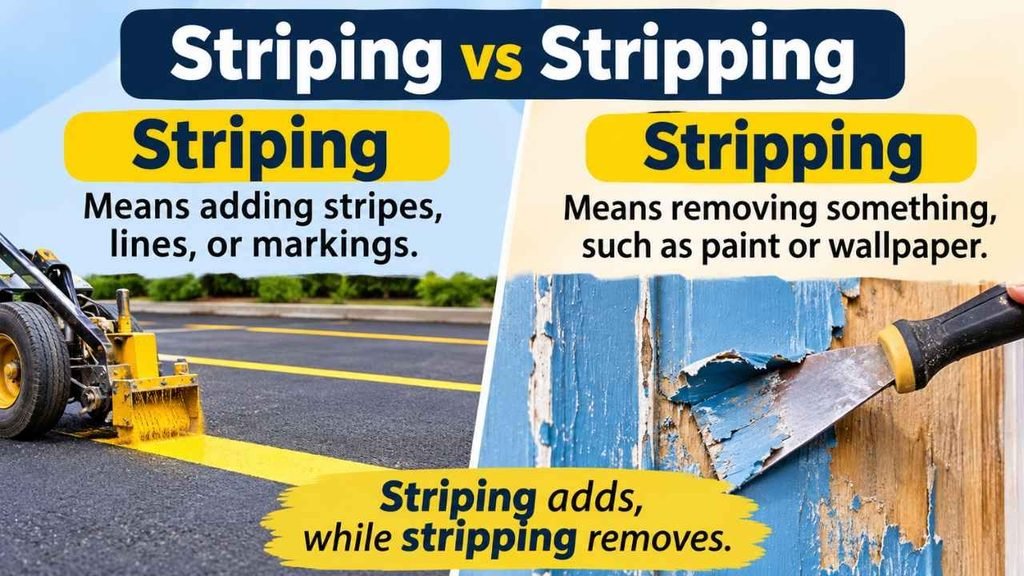
The main difference between striping and stripping lies in their meanings. Striping describes adding stripes or markings to something, whereas stripping describes removing something from a surface, object, or person.
Here is a quick comparison:
| Striping | Stripping |
| Comes from stripe | Comes from strip |
| Means adding stripes or lines | Means removing something |
| Often relates to patterns and markings | Often relates to removal or exposure |
| Example: Striping a parking lot | Example: Stripping old paint |
Examples:
- The workers are striping the parking lot with fresh white lines.
- The workers are stripping the old paint from the wooden doors.
In the first sentence, the workers add markings. In the second, they remove an existing layer of paint.
Remember this simple distinction: striping adds, while stripping removes.
What Does Striping Mean?
Striping is the -ing form of the verb stripe. It means adding stripes, lines, or bands to a surface or object. People commonly use this word when describing road markings, parking spaces, sports fields, clothing designs, and decorative patterns.
For example, workers may apply striping to a parking lot to show drivers where to park. Similarly, a painter might add decorative striping to a wall or piece of furniture. The word can also describe the process of creating striped patterns on different materials.
Consider these examples:
- The company specializes in striping parking lots.
- The artist is striping the wooden table with blue paint.
- Fresh road striping makes lane markings easier to see.
- The designer is striping the fabric with colorful lines.
In each sentence, striping involves creating or adding visible lines or bands.
What Does Stripping Mean?
Stripping is the -ing form of the verb strip. It means removing something, taking something off, or exposing what lies underneath. The word appears in several everyday and professional situations, including cleaning, renovation, electrical work, and clothing.
For instance, someone might strip old paint from a wooden surface before applying a new coat. An electrician might strip insulation from the end of a wire to expose the metal conductor. In another situation, a person might strip wallpaper before decorating a room.
Here are some examples:
- We are stripping the old paint from the furniture.
- The electrician is stripping the insulation from the wire.
- They spent the afternoon stripping wallpaper from the walls.
- The workers are stripping the damaged coating from the floor.
Each example describes removing an existing layer, covering, or material.
Why Are Striping and Stripping Spelled Differently?
The different spellings come from two English spelling rules. When you add -ing to a verb, you sometimes need to remove a letter or double the final consonant. The correct change depends on how the original verb ends.
1. Stripe becomes striping
The verb stripe ends with a silent E. When you add -ing, you drop the final E and keep the remaining letters.
- Stripe + ing = Striping
- Bake + ing = Baking
- Hope + ing = Hoping
2. Strip becomes stripping
The verb strip has one vowel followed by one final consonant. Because it is a short, one-syllable verb, you double the final consonant before adding -ing.
- Strip + ing = Stripping
- Run + ing = Running
- Sit + ing = Sitting
Cambridge Dictionary explains both the final-E rule and the consonant-doubling rule in its English spelling guidance.
Cambridge Dictionary+1
Here is a simple comparison:
| Original verb | Spelling rule | Correct form |
| Stripe | Drop final E | Striping |
| Strip | Double final P | Stripping |
| Bake | Drop final E | Baking |
| Run | Double final N | Running |
| Hope | Drop final E | Hoping |
| Sit | Double final T | Sitting |
These rules explain why striping has one P while stripping has two. Neither spelling is a mistake.
Striping vs Stripping Examples in Sentences
Looking at both words in complete sentences can help you understand when to use each one. Pay attention to the action described rather than just the spelling.
Examples of Striping
- The construction crew finished striping the parking lot before opening it to customers.
- The artist enjoys striping motorcycles with colorful designs.
- Fresh road striping helps drivers identify their lanes.
- The company offers professional striping services for sports courts.
- She is striping the wall to create a decorative pattern.
In these examples, striping refers to creating or adding lines, bands, or markings.
Examples of Stripping
- The workers are stripping the old paint from the wooden furniture.
- He spent the morning stripping the wallpaper from the bedroom walls.
- The electrician is stripping the wire before connecting it.
- They are stripping the damaged coating from the metal surface.
- She started stripping the old varnish from the table.
In these examples, stripping describes removing an existing covering, material, or layer.
Quick tip: If the sentence describes adding lines or patterns, use striping. If it describes taking something away, use stripping.
Common Mistakes to Avoid
People sometimes confuse these words because they differ by only one letter. However, using the wrong form can make a sentence confusing or change its intended meaning.
Here are some common mistakes and their corrections:
| Incorrect sentence | Correct sentence |
| The workers are stripping the parking lot. | The workers are striping the parking lot. |
| We need professional paint striping. | We need professional paint stripping. |
| The crew is striping the old paint. | The crew is stripping the old paint. |
| The electrician is striping the wire. | The electrician is stripping the wire. |
Notice how the correct word depends on the action.
- Parking lot striping: Adding lines to mark parking spaces.
- Paint stripping: Removing old paint from a surface.
- Road striping: Adding or refreshing road markings.
- Wire stripping: Removing insulation from electrical wires.
Another mistake is assuming that stripping is simply an incorrect version of striping. Both are legitimate English words, and each has its own purpose.
Easy Ways to Remember the Difference
If you often mix up striping and stripping, remember what each word does.
- Striping = Adding: Think about adding colorful stripes to a shirt or painting lines in a parking lot.
- Stripping = Removing: Think about stripping old paint from a wall or removing insulation from a wire.
You can also remember their original verbs:
- Stripe → Striping
- Strip → Stripping
The first verb ends in silent E, so you remove it before adding -ing. The second verb doubles its final P.
Try this simple test:
Which word belongs in the following sentence?
“The workers are _____ the old paint from the doors.”
Answer: Stripping, because the workers are removing paint.
This small distinction can help you choose the correct spelling whenever you write either word.
FAQs
Is striping a correct word?
Yes. Striping is a correct English word and the -ing form of stripe. It describes adding stripes, lines, or markings to something, such as a parking lot, road, or decorative surface.
Is stripping a correct word?
Yes. Stripping is the -ing form of strip. It means removing something, such as paint, clothing, wallpaper, or insulation. It is commonly used in everyday language and professional contexts.
Is it parking lot striping or stripping?
Parking lot striping is correct when you mean painting or applying lines to mark parking spaces. Stripping would suggest removing something from the parking lot rather than adding markings.
Is it paint stripping or striping?
Paint stripping is correct when you mean removing old paint from a surface. Paint striping would refer to adding stripes or decorative lines with paint.
Why does stripping have two Ps?
Stripping has two Ps because the base verb strip ends in a single consonant preceded by a single vowel. In this one-syllable word, the final P doubles before adding -ing.
Are striping and stripping pronounced differently?
Yes. Striping has a long I sound, as in stripe, while stripping has a short I sound, as in strip. The difference in pronunciation reflects their different base verbs.
Conclusion
Although striping and stripping look similar, they have different meanings. Striping refers to adding stripes, lines, or markings, while stripping means removing something, such as paint, wallpaper, or insulation.
The spelling difference comes from two simple rules: stripe loses its final E before adding -ing, while strip doubles its final P. Once you understand these changes, choosing the correct word becomes much easier. Remember: striping adds, and stripping removes.

Hi, this is a comment.
To get started with moderating, editing, and deleting comments, please visit the Comments screen in the dashboard.
Commenter avatars come from Gravatar.